Wednesday, 25 July 2012

Peaceful - John Sangster (1980)

This is the sort of music that ideally should be listened to while sitting on a pristine Australian beach with a beer, maybe enjoying a cheeky Winnie blue (or some of Australia's other well-loved herbal produce) while listening to the native birds calling in the coastal scrub. I'm a little surprised, in fact, that Sangster didn't incorporate field recordings of birdsong or other native bioacoustics into this LP as he has with so many of his others. (Especially with titles like 'Reed-warbler Song').

This set is quite consistent in its instrumentation, comprising acoustic guitar, vibes and other melodic percussion instruments, smooth sax and flute. Overall the LP is reminiscent of the quieter sections of Sangster's fantastic Australia And All That Jazz records. The relatively straightforward arrangements and breezy exotica feel also evoke the vibe of John Zorn pieces like The Gift.

This record is an artefact of late 20th century Oz exotica which evolved from an appreciation of Australia as something of a tropical paradise. (See Sangster's own aptly titled Paradise for an excellent example of this cultural phenomenon). And unlike the unobtainable island fantasies of the original American exotica wave of the late fifties, this was a paradise that was easily accessible to any Australian with a bit of time, a serviceable caravan and a desire to seek out their own Antipodean Eden. Sangster clearly loved to view Australia in this way. In a country that is often ashamed of celebrating it's own 'Australianess', Sangster's music stands out as an unabashed statement of what makes it worth celebrating.

Label: Rain-Forest
Released: 1980
Players: Errol Buddle - tenor saxophone
Mal Cunningham - flutes
Terry Walker - acoustic guitar
Tony Ansell - electric piano
John Sangster - vibraphone, marimba and percussion
Ian Bloxsom - percussion

Monday, 4 June 2012

Expanse - Andrew Richardson (1984)

Let me be succinct - this album is awesome. Picture this: a synth-heavy, flute-heavy, proggy concept album "inspired by the vast Australian Outback and Aboriginal Dreamtime stories that originated there". The musician responsible for this 'ballet' as it is described on the back cover is flautist Andrew Richardson, who seems to have been active in Melbourne in the eighties, but on whom I can find little information or context. I found a single of his called Sally/Dive a while ago at the same op-shop as I found this LP, but it didn't even hint at the greatness of which this man was capable.

Although the album only features two musicians, Richardson on flutes and Ian Eccles-Smith on keyboards, this is a full-sounding album with plenty of variation and dynamic range. Falling stylistically somewhere between Vangelis's eighties albums and a documentary soundtrack of a similar age, there are lots of ephemeral flutes, noisy synths and the occasional field recording of indigenous singing and percussion. Although it could be a little ambient (or god forbid "new age-y") for some listeners, there are some very strong, melodically driven tracks which are the definite highlights for me. The first such track is Tiddalik - The Frog which opens with the synth laying down a whimsical motif in 4/4 and then segues into a gorgeous, baroque waltz section lead by Richardson's flute - all the while augmented by deep, synth "croaks" representing the titular amphibian. The album closes with Brolga which is another lush waltz allowing Richardson to harmonise multiple haunting flute lines over some very effective synth bass.

This may just be due to my idiosyncratic musical tastes, but this LP represents a real lost gem to me and I urge you to have a listen if this sounds like your kind of thing.

EDIT: You may notice that keyboardist Ian Eccles-Smith says hello in the comments of this post and recommends his album Apsilene. I have just written a post on this piece and also conducted an email interview with Ian which you can read here

EDIT, 29/08/2019: I've just seen that Richardson, who now goes by 'Howlin' Wind', has uploaded a bunch of his stuff to Bandcamp. Including Expanse. I have removed the download link from this post, and encourage you to purchase this album from Howlin' directly.


Label: A.R.M.
Released: 1984
Players: Andrew Richardson - flutes
Ian Eccles-Smith - keyboards
(Richardson and Smith also arranged, produced and engineered the album.)

Monday, 28 May 2012

The Australian Ark - Derek Strahan (1970)

If I had to name an all-time favourite genre it would be nature documentary soundtracks - particularly if they're Australian and from the sixties or seventies. Admittedly, it's a fairly limited genre, so at this point, finding a new one (new to me, anyway) is pretty exciting. While doing a little wandering on the internet, I found the soundtrack to Shell's Australia; a thirteen part series by Robert Raymond documenting the natural history of Australia which originally aired in the early seventies. The soundtrack, titled The Australian Ark, was composed by Derek Strahan during 1969-70 and features the talents of a number of Oz jazz players including John Sangster and Derek Fairbrass. I've only been listening to it since I obtained it this morning, but from my initial impressions, it sounds really, really good. The inclusion of Sangster on percussion lends the soundtrack a very similar feel to Sangster's own soundtrack works and also the celebrated soundtracks of Sven Libaek. I don't have a rip of this album - it was never released on vinyl, although a cassette tape was released by Strahan in 1980 - but the whole thing can be purchased on CD or mp3 from CD Baby. Strahan seems to release all his music independently, so purchasing this album will directly support this Australian composer and his fine work.

If you want to hear some of the music in context, there are a couple of videos of the original documentary available at the National Film and Sound Archive's australianscreen site.


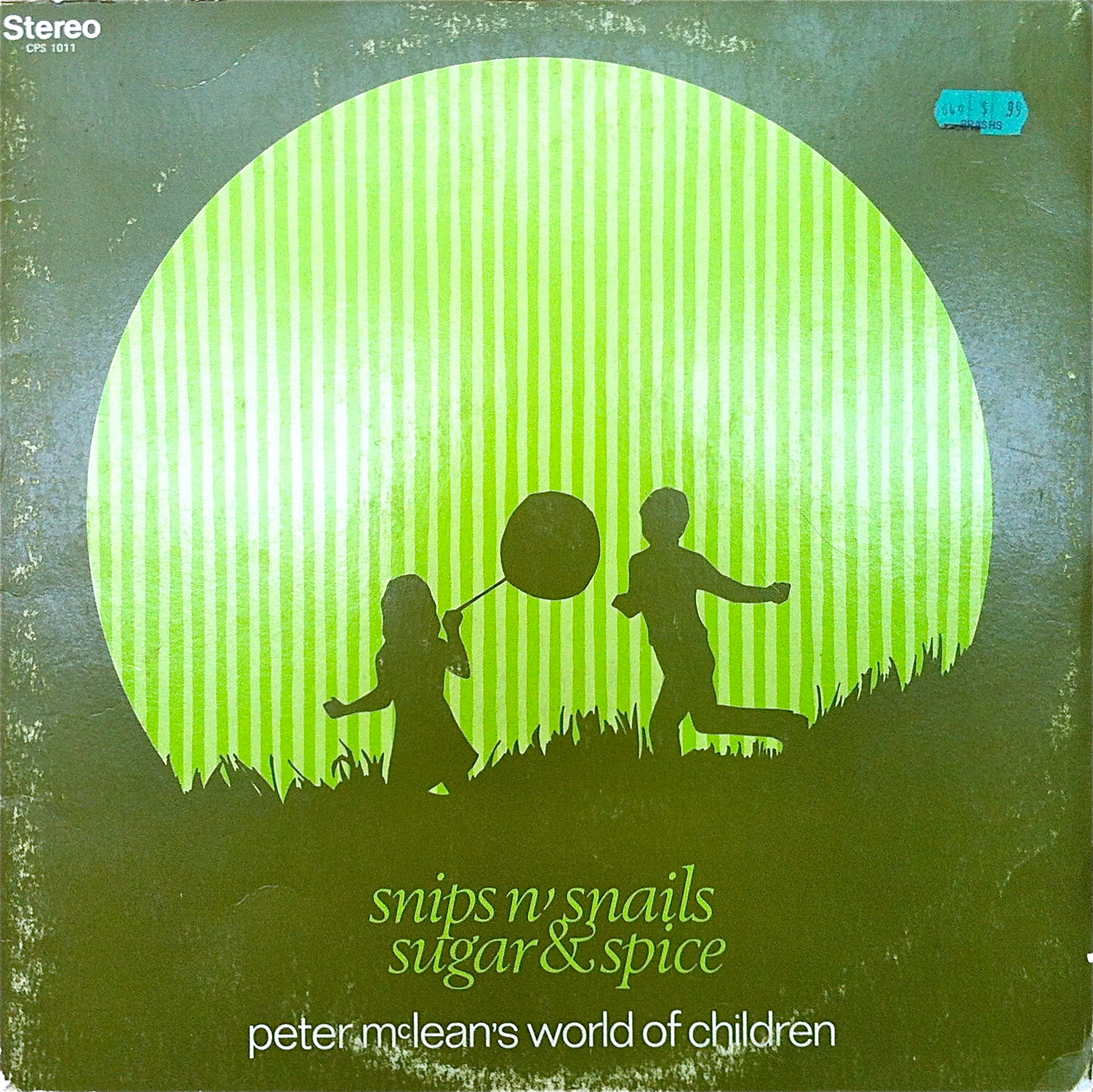
Snips N' Snails Sugar & Spice - Peter McLean (1973)

Snips N' Snails Sugar & Spice is another Australian children's folk record from the seventies. This one is by folk singer Peter McLean on whom I can find little to no information. All I can really deduce about the guy is that he either had a lot of money to spend on this record, or he was friends with some very good musicians; amongst the many players on the album are names such as Errol Buddle and Warren Daly. He also had the budget to put a lovely colour booklet as part of the cover featuring the lyrics and pictures of adorable children wearing very seventies clothing.

Although I was a little put off by the lyrical content at first - outside of it's original context, this whimsical seventies artefact can seem a little creepy - the quality of production, arrangement and the songs themselves are really very good. Like Shirley Jacobs, McLean inserts a little of that famous seventies social consciousness into some of the songs (although nowhere near to the degree of Jacobs). One of my favourite tracks 'If I Were A Child' contains the amusing refrain 'I'd wonder why they make me fight their dirty, stinkin' wars' delivered with utmost sincerity. The album also seems to have some connection with autistic children as there is a brief piece of text on the last page of the LP's booklet that mentions the Autistic Children's Association - although that's all it is, a mention, there's no further information or context, so who knows what McLean was trying to convey.

Occasionally embarrassing lyrical moments aside, this is a great children's folk record with strong melodies accompanied by a lot of instrumental layers; string sections, recorders, flutes, and choir vocals make this a very enjoyable listen.

Label: Cherry Pie
Released: 1973. I was able to work this out as one of the tracks 'Tom' was released as a single and is recorded as entering the charts at 48 in this year.
Players: Peter McLean - vocals
Peter Martin - electric guitar, acoustic guitars
Dave Ellis - bass
Jim Kelly - guitar
Warren Daly - drums
Dick Holland - electric piano
Lindsey Doyle - drums
John Harding, Cliff Hanney, Shirley Beauman, Nancy Clements, Janet Harvey, Francis Swales and John Lyle - violins
Nathan Waks, V. Vidler, Hans Gyors, Lal Kuring - cellos
Errol Buddle - concert flute, recorder
Col Loughnan - concert flute
Doug Foskett - alto flute
Dave Rutledge - alto flute
Warren Judd - baritone vocals
Ian Caldwell - tenor vocals
Lyndria Maywald - 2nd alto vocals
Lynne Martin - 1st alto vocals
Jan Judd - 1st soprano vocals
Jenny Parr - 2nd sopranos
Angela Cowl - 2nd sopranos


Mediafire.


Australia's Shirley Jacobs - Shirley Jacobs (197?)

Shirley Jacobs was a folk singer and anti war activist who was active in Melbourne during the seventies and eighties. She regularly performed for the inmates of Pentridge Prison and eventually fell in love with a prisoner who had been incarcerated for blowing the whistle on police corruption in Victoria. On this record Jacobs sings songs aimed at children, but her social consciousness comes through very clearly on most tracks. On 'Sad Eyed Teddy Bear' she sings about a young boy who grows up to fight in a war and dies. On 'Tribal Girl' she sings about an indigenous girl, a 'dreamtime girl' and 'the songs your people know'.

The social commentary mostly works okay in the children's song format, however there are some missteps such as 'Friendly, Green, Luminous Bear', a ham-fisted equating of the mistreatment of the titular bear with racism. (Also on this track, the bass player seems to be completely unfamiliar with the progression - it's amazing that they kept this take.) My favourite is 'I Know A Girl Who Looks Through Windows' - a lovely folk melody with a great interplay between major and minor sections. This is an interesting folk album although the lack of variety in melodies and arrangement can get a bit samey after a while.

Label: RCA Camden
Released: Unsure, probably early seventies.
Players: Shirley Jacobs - 12-string guitar
Ade Monsbourgh - recorder, melodica, trumpet
Doug Wallace - guitar
Peter Hayes - 5-string banjo
Jim Beal - drums, maraccas, glockenspiel, bells, triangle, tambourine
Frank Taylor - piano
Allan Pope - electric bass
Children of Essex Heights State School, Victoria join Shirley on the choruses of 'Sad Eyed Teddy Bear', 'Topsy On The Truck', 'Friendly, Green, Luminous Bear'.

Sunday, 27 May 2012

Don Burrows And The Brazilian Connection - Don Burrows Quintet, Sydney String Quartet, Octavio Burnier & Claudio Cartier (1979)

My view of 1970s Australia is derived entirely from pop-cultural artefacts. Through my incomplete, stochastic lens, the Australia of the seventies was a land far more isolated than today, infused with a unique kind of funky antipodean jazz. A land where flute was king, and Don Burrows reigned supreme as it’s finest exponent. It’s hard to imagine a time when a jazz flautist was the most successful and prolific of instrumentalists, but in the magic heyday of Australia in the seventies, anything was possible.
Like any prolific musician, Burrows has his hits and misses. The first record of his I ever bought - Don Burrows Presents The Brazilian Connection, is one of the hits. This is a double live LP recorded in 1978 at the Sydney Opera House and Canberra Theatre featuring the Don Burrows Quintet, the Sydney String Quartet and two Brazilian singer-songwriters; Octavio Burnier and Cluadio Cartier. Each track features a performance played by different permutations of these musicians. For example, some tracks feature just the Brazilians with the string quartet, some feature all the ensembles playing together, a couple feature the classic duo lineup of Burrows and guitarist George Golla and so on.

Although this is Don’s record, the Brazilians - Burnier and Cartier - steal the show. Tracks like 'Don João (King John)', 'Sitio Azul (A happy, country weekender)', 'Adventura Espacial (Adventure in space)' and 'Recreio (Playtime)' have a beautiful sound, particularly when the guitarists are accompanied by the string quartet. Although the overtly jazz flute feel of much of the LP has dated somewhat, the songs by Burnier and Cartier still sound very fresh and quite contemporary.

That being said, the tracks featuring all the players are amongst the best material on the LP. My favourite track on the LP is probably 'Lembrando Ed Kleiger (Remember Ed Kleiger)'. Opening with the Brazilians singing a gorgeous melody over a funky backing from the Don Burrows Quintet, highlighted with flourishes from the Sydney String Quartet which then segues into seven odd minutes of extended solos from our esteemed players. 'Lenda das Amazonas (Legend of the Amazons)' is another track where the players go all in, follows much the same format as the latter tune and is equally as good.

Don Burrow’s albums seem to be less sought out and celebrated than those by other Oz jazz players of the seventies - possibly due to their sheer abundance. This LP however, is well worth a listen and easily holds its own in comparison with other lauded Australian jazz LPs from this era.

Label: Cherry Pie
Released: 1978 (Recorded live at Sydney Opera House and Canberra Theatre)
Players: Don Burrows - flutes, clarinet, percussion
George Golla - guitar, percussion
Tony Ansel - electric piano, synth, percussion
Paul Baker - bass, percussion
Paul Jansen - percussion


Octavio Burnier & Claudio Cartier - 6 and 12 string guitar, vocals, percussion


Harry Curby - 1st violin, percussion

Derel Tincu - 2nd violin, percussion
Alex Todicescu - viola, percussion
Nathan Waks - cello, percussion


Mediafire.


Sunday, 29 April 2012

Bush Theme/Lonely Australian Landscape - Sven Libaek (1966)


Here's another gem from Urban Bowerbird favourite Sven Libaek. These two tunes are taken from the nature documentary soundtrack Nature Walkabout, however these are quite different versions to the tracks that appear on the LP. These versions are shorter and have faster tempos than the album versions and a few changes in orchestration and arrangement. The two tracks also seem to be played by a more stripped-down version of Sven's usual ensemble - there are no saxophone, flute or trumpet parts, just piano, guitar, bass, vibes and harmonica on Bush Theme. I am unsure why different versions of these songs were released on the single - is this a standard practice? I have a 7" single from Libaek's Inner Space soundtrack (Thatcherie/Sounds Of The Deep) and it contains exactly the same versions as featured on the LP. Weird.

I always felt that Bush Theme was one of the weaker tracks on Nature Walkabout and I think the increase in tempo and the concision of this arrangement improves it immeasurably. Lonely Australian Landscape on the other hand is one of my favourite of Sven's compositions and I like it even better with this pacing and arrangement. It takes what is already a great melody and gives it an incredible urgency and energy.

Label: Festival
Released: 1966 (I assume; that's when the Nature Walkabout soundtrack was released.)
Players: Unsure, but here's an educated guess: Sven Libaek - piano
 
George Golla - guitar
John Sangster - vibes, percussion
Ed Gaston - bass
Derek Fairbrass - drums

Richard Brooks - harmonica

Mediafire.